Board of Peace Watch
Board of Peace Watch tracks the Board of Peace, the international body chaired by President Trump to oversee Gaza’s postwar governance and reconstruction. The Board controls billions in pledged funds and is shaping Gaza’s future, with little public accountability and no authorization from Congress.
We follow the money, the decisions and the people behind the Board, and we publish clear, sourced information for the public and for congressional offices. Our goal is to inform, educate and equip Americans and their representatives.
Board of Peace Watch is a project of Dar Alhurriya – Palestine House of Freedom.
The Board of Peace: What You Need to Know
November 10, 2026
The Board of Peace is an international body chaired by President Trump to oversee Gaza's postwar governance and reconstruction. Nearly a year after the UN endorsed it, the Board has billions in pledges, little to show on the ground, and no authorization from Congress.
Who Runs It
• One man holds the power. Under the Board's charter, President Trump selects its executive board, can veto its decisions and has the final word on what the charter means. He may keep these powers after he leaves office.
• Executive board members include Jared Kushner, Steve Witkoff, Secretary of State Marco Rubio and former British Prime Minister Tony Blair.
• Membership is by invitation. About 28 countries have joined, and a permanent seat costs $1 billion.
• Gaza's day-to-day administration is assigned to a committee of Palestinian technocrats that reports to the Board.
The Money
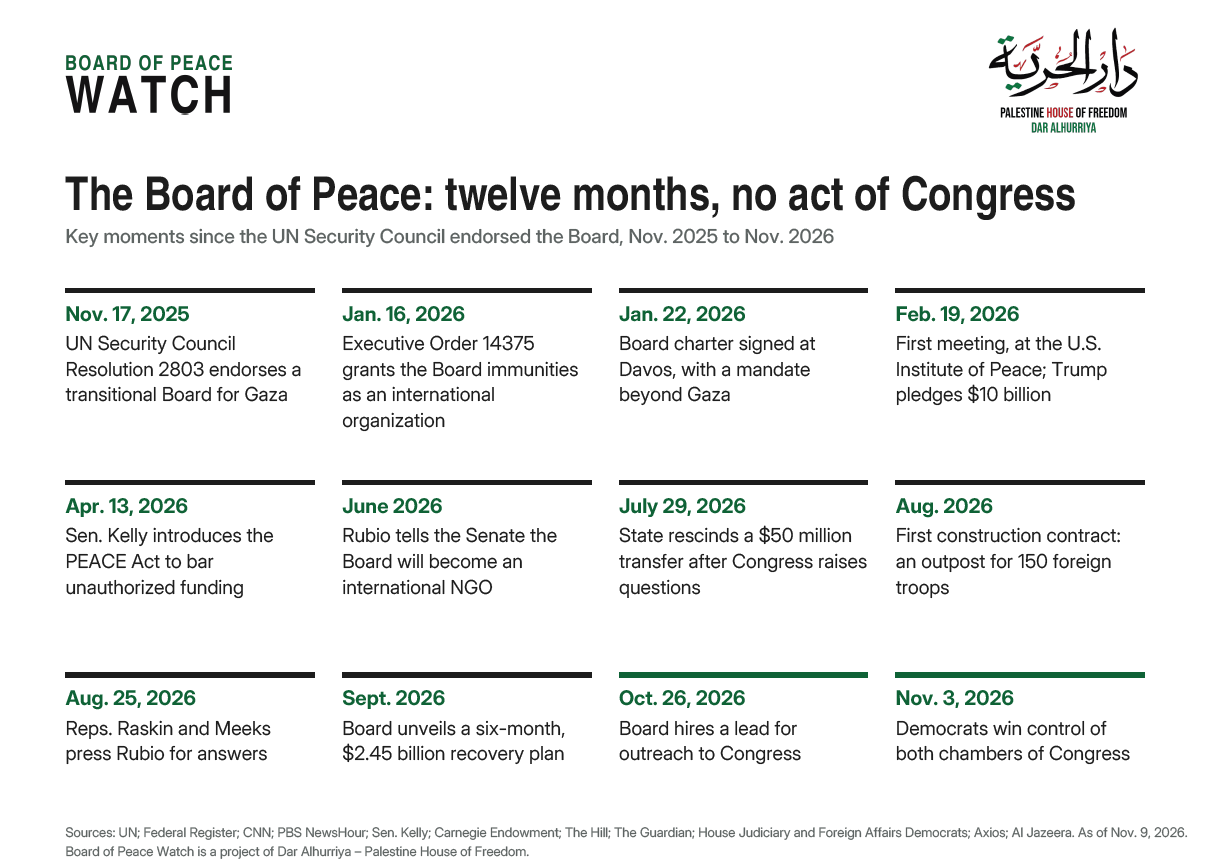
• $10 billion in U.S. taxpayer funds was pledged by President Trump at the Board's first meeting in February. Member countries pledged another $7 billion.
• Congress has never authorized or funded U.S. participation in the Board, by law or by treaty.
• The State Department tried to send $50 million to the Board, then pulled it back in July after members of Congress asked questions it could not answer.
• Foreign money is flowing. Morocco and the United Arab Emirates had sent more than $100 million by August. Donors can deposit directly into the Board's private J.P. Morgan accounts, and as of August, the Board had published no accounting of what it receives or spends.
On the Ground in Gaza
• A small plan for a vast need. In September, the Board unveiled a six-month, $2.45 billion recovery plan. The UN and World Bank estimate Gaza needs about $70 billion.
• Its first construction contract was for a military outpost, not homes or hospitals: a base for 150 foreign troops, awarded in August. As of mid-October, it was still stalled awaiting Israeli approval.
• Little has moved. As of early November, the Palestinian committee had not entered Gaza and the international stabilization force had not deployed, amid disputes over Hamas disarmament and Israeli approval.
Why It Matters to You
• It's your money. One person promised $10 billion in public funds without a vote of the people's representatives.
• No one is answerable. There is no public audit or accounting of the Board's funds, and the chairman's powers could outlast his presidency.
• Gaza's future is at stake. Decisions about how more than 2 million Palestinians are governed and how their homes are rebuilt rest with a body controlled by one man.
• Congress can act. The Board is now courting lawmakers directly. Ask your members of Congress where they stand on funding the Board without congressional approval.
Sources UN Security Council Resolution 2803 (2025); Executive Order 14375 (Jan. 16, 2026); Reps. Raskin and Meeks, letter to Secretary Rubio (Aug. 25, 2026); Sen. Shaheen, letter to Secretary Rubio (June 11, 2026); The New York Times (Jan. 18, 2026); CNN (Jan. 22, 2026); PBS NewsHour (Feb. 19, 2026); The Hill (Aug. 25, 2026); Axios (Sept. 23, 2026); Carnegie Endowment for International Peace (March 2026); The Guardian, as reported by The Jerusalem Post (Aug. and Oct. 2026); Al Jazeera (Oct. 10, 2026); Yahoo News (Nov. 5, 2026).
Board of Peace Timeline